



Frameworks, core principles and top case studies for SaaS pricing, learnt and refined over 28+ years of SaaS-monetization experience.
Thank you! Your submission has been received!
Oops! Something went wrong while submitting the form.
.png)
.png)
For the past 15 years, SaaS has been the dominant software model: recurring revenue, high gross margins, and near-zero marginal cost to serve. That model is now under pressure. AI is accelerating software commoditization, and what is emerging in its place is a new class of products that do more than help humans use software. They increasingly perform the work themselves. That is why the future of software is agentic AI.
Agentic AI combines AI models with agent capabilities so that software can plan, act, and deliver outputs with far less human involvement. Traditional SaaS still required a human in the seat using the tool to produce the result. Agentic AI changes that. The agent increasingly performs the work itself. That shift changes how value is created, and it changes how pricing has to work.
At Monetizely, we help companies build pricing strategies for products that think, act, and deliver outcomes on their own. We do not treat agentic AI pricing as a buzzword exercise. We treat it as a strategic monetization problem that touches segmentation, packaging, pricing metric, price point, cost structure, and go-to-market execution.
Our point of view is simple: the companies that win in agentic AI will not just have better models. They will have better monetization architecture. That means packaging the right offers for the right buyers, choosing a pricing metric that aligns with the work the agent performs, and setting rates that capture value without creating friction.
To do that well, we use the Agentic Monetization Spectrum (AMS) a framework we developed to map an AI agent’s properties to the right pricing decisions.
AMS evaluates an agent across three dimensions:
1. Zero Human Ability
How much human involvement does the agent still need? If the human remains the anchor, per-seat pricing may still work. If the agent is doing most of the work, pricing needs to move closer to output or outcome.
2. Operational Domain
Is the agent helping with one task, one workflow, or work across multiple functions? A narrow agent behaves like a tool. A broader one begins to look more like a job function or even a department.
3. Output / Cost Curve
What is the relationship between the value the agent creates and the cost to run it? If value and cost move together, cost-based logic may still work. If output value massively exceeds compute cost, cost can no longer be the main anchor for pricing.
The purpose of AMS is not to push companies toward a single pricing structure. It is to help identify the pricing strategy and monetization architecture that best fit your product, your buyers, and your market.
Most AI pricing conversations go nowhere. One person says “let’s do outcome-based pricing.” Someone else says “per seat is safer.” Then the team starts copying competitors. That is not strategy.
The fundamentals of pricing have not changed: who you sell to, how you package, what metric you charge on, and what price you set. What has changed is the commercial nature of the product. Agentic AI creates new tensions inside the same old pricing framework, and that is where a lot of money is either made or lost.
The companies that get this right build businesses that scale with the value their agents create. The ones that get it wrong either leave revenue on the table or price themselves out of markets that are moving faster than any market in software history.
The question is no longer whether agentic AI is changing software. It already is. The question is how you will price for it. We help AI and software companies answer that question with a practical framework, strong economic logic, and a pricing strategy built for products that think, act, and deliver outcomes on their own.
We do not just provide a price point. We provide an end-to-end operational roadmap to ensure your AI agents are both profitable and competitive. Our consulting engagement includes six critical workstreams designed for the agentic economy.
1. Strategic Customer Segment Review
We conduct a detailed analysis of your market to prevent ICP Drift. We cluster your customers into segments based on their needs and usage intensity.
2. Package Architecture and Design
We structure tiered or bespoke packages that align with diverse enterprise requirements. By mapping your agent capabilities to specific segments, we recommend bundling that drives deal velocity.
3. Price Metric Selection via the AMS
Using our proprietary Agentic Monetization Spectrum (AMS), we select the most scalable pricing metric for your product. We help you choose between outcome-based, task-based, or hybrid models.
4. Unit Economics and Cost Audit
We perform a deep assessment of your product costs, including infrastructure and inference expenses. We help you understand your Cost of Goods Sold (COGS) to protect your gross margins.
5. Data-Driven Price Point Selection
We determine targeted price points using market research, historical costs, and competitive comparables. Our goal is to find the Willingness to Pay (WTP) threshold.
6. Market Testing and Operationalization
We do not stop at strategy. We assist with survey-based research to pilot your new pricing models and provide the Bill of Materials for your rollout.
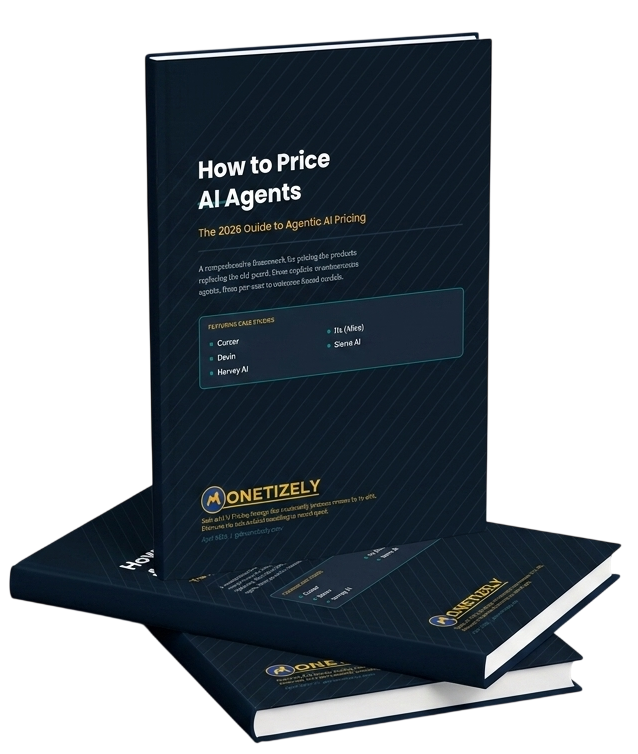
A comprehensive framework for pricing the products replacing the old guard. From copilots to autonomous agents, from per-seat to outcome-based models.
Featuring Case Studies

Join companies like Zoom, DocuSign, and Twilio using our systematic pricing approach to increase revenue by 12-40% year-over-year.